
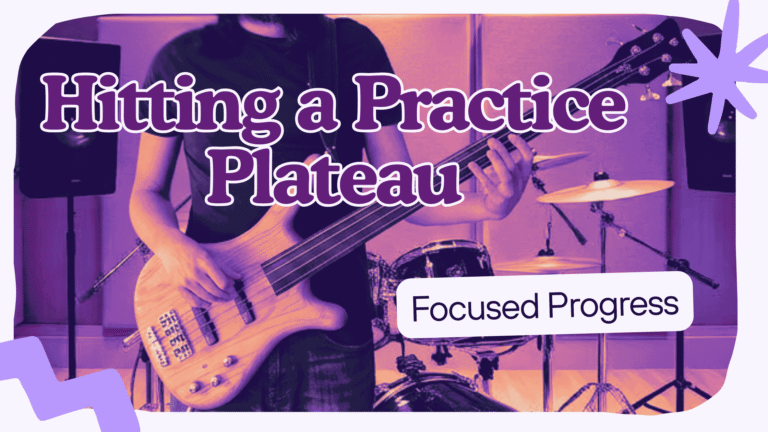
Have you been playing for a while, but progress has suddenly slowed to a crawl? You’ve hit a bass guitar plateau — and you’re nowhere near alone. It’s one of the most common messages I get from students: “I don’t feel like I’m getting any better.” The good news is there’s a reason it happens, and there’s a way through it.
Why You Hit a Bass Guitar Plateau
Once you can play comfortably, something strange happens: you stop noticing what you’re actually doing. Musicians call this the “autonomous stage” — you’re on autopilot, running through familiar patterns without consciously pushing anywhere new. It feels like practice, but it’s really just repetition. And repeating things you’ve already mastered won’t move you forward. It just reinforces where you already are.
The Fundamentals Most Players Skip
A lot of bassists get stuck at the same level for months, sometimes years. They haven’t run out of things to learn — they’ve just stopped addressing fundamentals they overlooked early on. Fretboard knowledge beyond your usual positions. Real ear training, rather than relying on tab. Clean, efficient technique instead of chasing raw speed. These are the unglamorous basics that keep paying off long after you’ve left “beginner” behind. Skip them, and you’re on one of the quickest routes to a bass guitar plateau.
Why Even Professional Bassists Keep Taking Lessons
Here’s something that surprises a lot of intermediate players: even professional musicians keep taking lessons. It’s not because they don’t know what they’re doing. It’s because an outside pair of ears catches things you can’t hear in your own playing. A good teacher spots the habit you didn’t know you’d built. Then they give you something specific to work on, instead of vague advice to “practice more.” Stagnation isn’t a sign you’ve reached your ceiling. It usually just means you’ve been marking your own homework for too long.
One of the Fastest Ways Off a Bass Guitar Plateau: Go Fretless
If autopilot is the problem, the fix is anything that forces you to pay attention again. Few things do that faster than picking up a fretless bass. Without frets to fall back on, you can’t rely on muscle memory alone. Your ear has to lead every note, and your fingers have to fine-tune pitch in real time. That heightened awareness carries straight back into your fretted playing too. It’s one of the most effective ways I know to break a genuine bass guitar plateau. It simply doesn’t let you cruise.
Ready to Try Fretless?
If you already play fretted bass and want the next real challenge, try my Beginning Fretless Bass course. It takes you from first notes to genuinely playing in tune, without frets to lean on. And if gear has ever felt part of your plateau story, revisit this: technique, not equipment, actually moves you forward. Prefer working through it 1-to-1? Book a lesson and we’ll pin down exactly where your plateau is coming from.